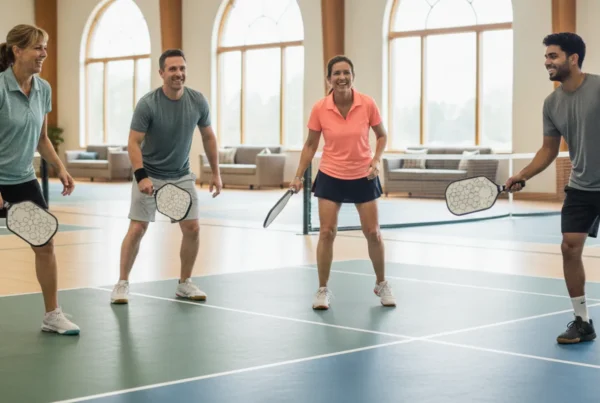

A good pickleball routine does not begin with playing every day. It does not require mastering every shot at once. It begins with a schedule you can repeat, a little focused practice, and enough time on court to make the game feel familiar. For a beginner, consistency matters more than intensity.
To learn how to build a pickleball routine, start with two or three manageable sessions each week. Mix a brief warm-up, one or two focused skills, and relaxed play, then adjust the pace as your comfort and confidence grow.
That approach also leaves room for the social side of the sport, whether you play singles or doubles. The CDC notes that weekly activity can be spread across smaller chunks of time, so a short practice still counts toward a sustainable routine. If you are exploring places to play, learn more about Chagrin Falls racquet sports at The Wembley Club. Next, consider how often to schedule those sessions so progress stays enjoyable rather than overwhelming.
How to Build a Pickleball Routine Each Week
A repeatable routine matters more than trying to play every day. Start with two or three pickleball sessions per week, leaving a day between harder sessions when you are still learning how your body responds. One session can focus on basic shots and movement, while another can be relaxed doubles play. A third session is optional if you feel recovered and can keep it enjoyable.
As a general activity reference, the CDC recommends 150 minutes of moderate-intensity activity per week for adults, along with muscle-strengthening activity on at least two days. That is general guidance, not a pickleball prescription. Moderate effort generally means breathing harder and raising your heart rate while still being able to talk, though not sing. Doubles court sports are one example of activity that can fit this effort level.
A practical beginner week
- Monday: Strength work, such as controlled bodyweight exercises, plus a short walk if desired.
- Tuesday: Pickleball practice for 30 to 45 minutes. Keep the focus narrow, such as ready position, serves, or returning the ball.
- Wednesday: Rest or light movement. The goal is to keep activity manageable, not to make every day a demanding court day.
- Thursday: Casual doubles play for 45 to 60 minutes. Concentrate on positioning and making consistent contact rather than keeping score.
- Saturday: Optional practice or social play, followed by another strength session on a separate day if that fits your schedule.
You can also divide activity into smaller blocks across the week instead of completing it all at once. If 150 minutes feels like too much at first, begin with the amount you can manage consistently and build gradually. Some activity is better than none. Use your energy, comfort, and recovery as feedback, and adjust the number or length of sessions rather than forcing a fixed target.
What Skills Should You Practice First?
When you are learning pickleball, consistency matters more than collecting a long list of shots. A simple practice plan should help you control the ball, recover to a balanced position, and recognize where the next shot should go. Start with a few repeatable skills, then add game situations as those basics begin to feel comfortable.
- Grip and ready position: Hold the paddle comfortably rather than squeezing it tightly. Between shots, keep the paddle in front of your body, your knees soft, and your weight ready to move in either direction. This gives you a reliable starting point for returns and quick exchanges.
- Compact swings: Practice short, controlled swings instead of reaching for a large backswing. A compact motion is easier to repeat and helps you keep the ball in play when the pace increases.
- Serves and returns: Work on a consistent serve that lands in the correct service area, then practice returning with enough height and depth to give yourself time to move into position. Accuracy and recovery are better early goals than trying to hit the hardest possible serve.
- Dinks: From near the non-volley zone, practice soft shots that arc over the net and land in the opponent’s kitchen. The goal is touch and control. Keep the ball low enough to make an aggressive reply difficult, but do not force a perfect shot every time.
- Two-tap exchanges: With a partner, tap the ball back and forth at a manageable pace. This focused drill develops paddle control, hand-eye coordination, and comfort with short rallies. Increase the pace only when both players can maintain control.
- Drop shots: Practice taking a deeper ball and landing it softly in the non-volley zone. Begin with a comfortable distance and focus on a repeatable arc, then gradually vary your position on the court.
Keep each drill focused. A partner and a court are enough to work on many essential skills, so you do not need to turn every practice into a full game. Spend a few minutes on one skill, pause to notice what changed, and repeat it before moving on. That structure makes it easier to see progress and build a routine you will actually enjoy.
Rules and scoring will make more sense as you practice them in context. For a clear refresher, review this guide to pickleball rules and scoring, then return to the court and apply one point of the guide during your next session.
How Should You Structure a Pickleball Practice Session?
A repeatable session makes it easier to improve without turning every visit to the court into an exhausting scramble. The goal is to give your body time to prepare, your skills time to receive focused attention, and your game time to test what you practiced. Adjust the timing to your experience, energy, and available court time. This is a practical framework, not a clinical requirement.
- Warm up for 8 to 10 minutes. Start with easy movement that gradually raises your temperature, then add dynamic motions you will use on court. Harvard Health lists squats, forward lunges, side lunges, arm circles, and jumping jacks as possible warm-up movements before play: see its pickleball safety guidance. Keep the effort comfortable and controlled. Use this time to check your shoes, paddle, and court area, and to notice whether anything feels unusually stiff or painful.
- Spend 15 to 20 minutes on one or two focused drills. Choose a small skill goal instead of trying to fix everything at once. You might work on a consistent serve, soft shots near the kitchen, or returning the ball to a specific target. Begin slowly enough to notice your contact point and balance, then add pace only when your form feels steady. A short, purposeful block often gives you more useful feedback than an hour of unfocused hitting. If a coach or qualified instructor has given you technique advice, use this portion to practice that specific adjustment.
- Play or rally for 20 to 30 minutes. Move from isolated practice into cooperative rallies, then open play if the group and court setting allow it. Give yourself a simple match objective, such as keeping the ball in play or choosing a safer target. You are not required to win every point for the session to be valuable. Notice whether the drill you practiced appears naturally during play, and make a quick mental note of situations that still feel difficult.
- Cool down and reflect for 5 to 10 minutes. Reduce your pace gradually, walk for a few minutes, and use gentle stretches that feel comfortable. Harvard Health emphasizes preparation before play, while a calm finish gives you space to assess how the session went. Write down one success, one question, and one skill to revisit next time. If you have a health concern, a significant condition, or pain that persists, seek advice from a qualified health professional before changing your activity routine.
As you learn how to build a pickleball routine, keep the structure familiar while changing the drill or play goal. Consistency helps you see progress, and leaving room for enjoyable rallies keeps practice feeling like pickleball rather than homework.
How Do You Balance Drills and Open Play?
Drills and open play serve different purposes, and a beginner benefits from making room for both. Focused practice lets you repeat one skill without the pressure of keeping a rally alive. Open play teaches you when to use that skill, how to move with a partner. And how to make decisions when the ball does not arrive exactly where you expect.
A practical starting point is to use drills for a portion of each practice session, then finish with relaxed games. You might spend 20 minutes working on dinks, serves, drops, or two-tap progressions before playing. The exact split can change as your confidence grows. If you are still struggling to make consistent contact, give practice more attention. If your strokes feel comfortable but you hesitate during points, play more and notice which situations cause trouble.
| Part of practice. | Best for. | How to use it. |
|---|---|---|
| Focused drills. | Building consistency, touch, and confidence. | Repeat one shot or pattern with a partner, then change the target or placement. |
| Open play. | Decision-making, movement, and adapting to real points. | Play normally, but choose one simple focus, such as returning safely or moving into position. |
Keep drills purposeful rather than treating them as a test. For example, start with controlled dinks, then add movement or a change of direction. A serve drill can help you find a repeatable motion, while a drop drill can teach you to exchange power for height and placement. When a mistake appears in open play, remember it and return to that situation during your next practice instead of trying to fix everything at once.
Wembley Club programming in Chagrin Falls gives beginners and recreational players ways to build consistency within a welcoming racquet-sports community. You can explore Wembley pickleball programming and choose a practice-and-play mix that feels sustainable. The best routine is not the one with the most drills. It is the one that helps you keep learning, enjoy your games, and come back ready for the next session.
Should Beginners Take Lessons or Learn By Playing?
For most beginners, the best answer is not lessons or playing. It is a combination of guidance and enjoyable time on the court. A lesson can help you understand the ready position, serve, return, and basic movement before inefficient habits become comfortable. Playing with others then gives you a chance to recognize those skills in real points, make decisions, and grow more relaxed.
Think of instruction as a map rather than a finish line. You do not need to master every stroke before joining a game. A coach or instructor can watch a few repetitions, offer one or two useful adjustments, and give you a simple focus for your next practice. That might be keeping your swing compact, getting back to a ready position, or choosing a higher-percentage shot instead of trying to hit a winner. Focused feedback is especially useful when you are unsure why a ball keeps going into the net or out of bounds.
When guided practice helps most
Consider a lesson, clinic, or drill session when you want a clear starting point, are returning after time away, or feel stuck despite playing regularly. Guided work gives practice a purpose. Instead of hitting randomly for an hour, you can repeat one skill, notice what changes, and then test it during live play. It can also make the first few visits feel less intimidating because you know what to expect and have a chance to ask questions.
The Wembley Club offers pickleball clinics, managed play, and drill sessions as part of its Chagrin Falls racquet-sports programming. Availability and format can vary, so confirm current details rather than assuming every option is a recurring beginner class. You can explore Wembley pickleball programming to see how the club supports players who want both structure and community.
Why social play still belongs in your routine
Lessons cannot replace the experience of reading a moving ball, communicating with a partner, and adapting to different playing styles. Social play builds those skills while making consistency easier to maintain. Pickleball also has a strong community element, which can make a routine easier to maintain when you choose a welcoming group and a comfortable level.
A practical pattern is to alternate guided and social sessions: learn one skill, drill it with intention, then play enough points to use it naturally. Afterward, write down one thing that felt better and one question to revisit. That small loop helps you build a pickleball routine that is structured without becoming rigid, and social without leaving your progress to chance.
How Do You Find Players and Stay Consistent?
The easiest way to keep playing is to make pickleball part of your social calendar, not a task you have to tackle alone. Start by asking one friend, family member, or coworker to choose a regular time to play. If your first partner is also learning, that is fine. A shared beginner goal can make the early sessions more relaxed and give both of you a reason to return.
Pickleball can be played as singles or doubles, so you have more than one way to build a group. Doubles is often a comfortable starting point because it gives you two people to learn with and creates natural opportunities to meet other players. As your confidence grows, try practicing with different skill levels. Playing with someone a little more experienced can expose you to new positioning and shot choices. While playing with another beginner gives you space to work through the basics.
Choose a schedule you can repeat
When you are figuring out how to build a pickleball routine, choose a realistic commitment rather than an ambitious one. One planned session each week is a useful starting point. Add a second session when the first feels manageable, or use a shorter practice for serves, footwork, or controlled rallies between games. Put the session on your calendar, confirm it with your playing partner, and decide what happens if one person has to cancel. A simple backup plan, such as inviting another player or rescheduling before the week ends, keeps one missed day from becoming a missed month.
Track progress without overcomplicating it
After each session, write down one thing that felt better and one skill to revisit. You might note that your serves landed more consistently, you reached more balls with balance, or you remembered to call the score before serving. These small observations make improvement visible when the game still feels new. They also give your next practice a clear focus instead of leaving you wondering what to do.
Look for welcoming opportunities to play with beginners and recreational players, then let conversation do some of the work. A quick introduction and a specific invitation, such as asking whether someone would like to play again next week, can turn a casual game into a dependable connection. Consistency comes from a manageable plan, supportive people, and enough variety to keep playing enjoyable.
How The Wembley Club Helps New Pickleball Players Get Started
Starting a new sport is easier when you have more than a court and a paddle. At The Wembley Club in Chagrin Falls, Ohio. New pickleball players can build confidence through a mix of court access, skill development, and welcoming opportunities to play with others.
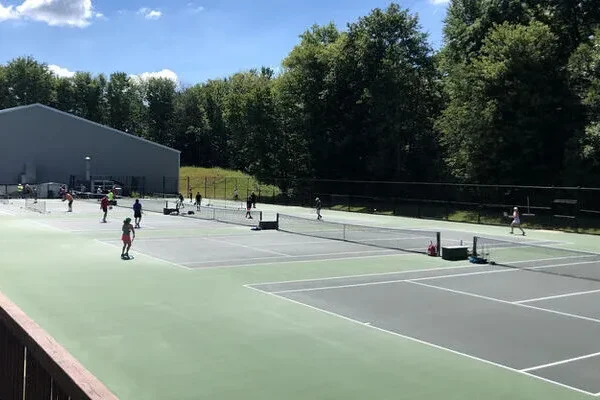
The Chagrin Falls facility has 12 pickleball courts, including indoor, air-conditioned courts. That setting gives members a comfortable place to keep practicing through changing weather and different seasons. Member court access also makes it easier to turn occasional games into a repeatable habit. If you are learning how to build a pickleball routine, having a familiar place to play can remove one of the biggest barriers: figuring out where your next practice will happen.
Start with structured practice, then add play
Beginners do not need to master every shot before they join a game. A useful early routine can combine focused practice with time on the court. Drill sessions can help you work on a specific skill, such as controlling the ball, finding a comfortable swing, or keeping a rally going. Once you have practiced the basics, playing gives you a chance to use those skills in a more natural setting.
The Wembley Club also offers pickleball clinics and managed play. These formats can give newer players more direction than trying to learn everything alone. Managed play can help create a smoother introduction to the social side of the sport, while clinics provide an opportunity to focus on instruction and skill development. Program details can vary, so prospective members should ask the club which current options best match their experience level.
Find a broader racquet-sports community
Pickleball is part of The Wembley Club’s broader racquet-sports programming. That matters for beginners who want to stay active, meet other players, and keep improving without treating every session like a test. A welcoming racquet-sports community can make it more enjoyable to return, even on days when your shots do not feel perfect.
To learn more about the club’s courts and racquet-sports environment, explore Chagrin Falls racquet sports. You can also review Wembley pickleball programming as you decide what kind of support would help you take your next step.
Frequently Asked Questions
Is two hours of pickleball a good workout?
It can be, especially when the session includes active play, focused drills, and short breaks rather than two hours of nonstop games. Your effort depends on singles or doubles, pace, court movement, and your current fitness. Build duration gradually and use your breathing, energy, and recovery as practical guides.
How long should a beginner pickleball practice session be?
Start with a manageable session that includes a dynamic warm-up, 10 to 15 minutes of one skill, several games or guided points, and a brief cooldown. A shorter practice you can repeat consistently is more useful than an exhausting session that leaves you unable to play for several days.
How many days a week should a beginner play?
Two or three pickleball sessions per week can give you regular practice without making every day a hard court day. You can also spread activity into smaller chunks across the week. The CDC recommends that adults aim for 150 minutes of moderate activity weekly and include muscle-strengthening work on at least two days. While emphasizing activities appropriate for individual ability: CDC physical activity guidance.
Should I take lessons before playing open games?
You do not need to master every rule before you play. A lesson or guided drill session can help you learn a ready position, compact swing. Serve, and basic court movement, while open play helps you apply those skills with real timing. Choose a welcoming group where you can ask questions and play at a comfortable level.
Ready to Build Your Pickleball Routine?
A consistent routine is easier to maintain when you have welcoming places to practice, play, and connect with other players. The Wembley Club can help you explore a beginner-friendly path that fits your goals and keeps pickleball enjoyable. Schedule a Tour to learn how the club can support your next step.